Introduction
The alert lands at 2 AM. Packet loss on a major traffic path. It’s not a link down. Everything looks up. But something’s wrong with how traffic is getting there.
The monitoring tool can’t figure it out. So the alert escalates to her.
She knows what it is. She’s seen this pattern before. A peering link degraded and traffic rerouted to a congested path. But the organization doesn’t have it documented anywhere. It lives in her head. So every time it happens, she’s the only one who can fix it.
Except with Agentic NetOps, the diagnosis is already there. The platform mapped the traffic path the moment the loss started. Which links it’s using, where the packets are dropping, what changed. The answer is waiting in the alert.
She moves from reactive triage to strategic design.
What follows is not an argument for replacing her. It is an argument for promoting her. Agentic NetOps, when done right, does not eliminate the knowledge that lives in your best engineers. It means your best engineers spend their time building things, not fighting fires only they can put out.
SECTION 1
The Taxonomy Your Team Already Knows
Here is what the Director of Network Operations understands intuitively but rarely hears named: most network incidents are not novel.
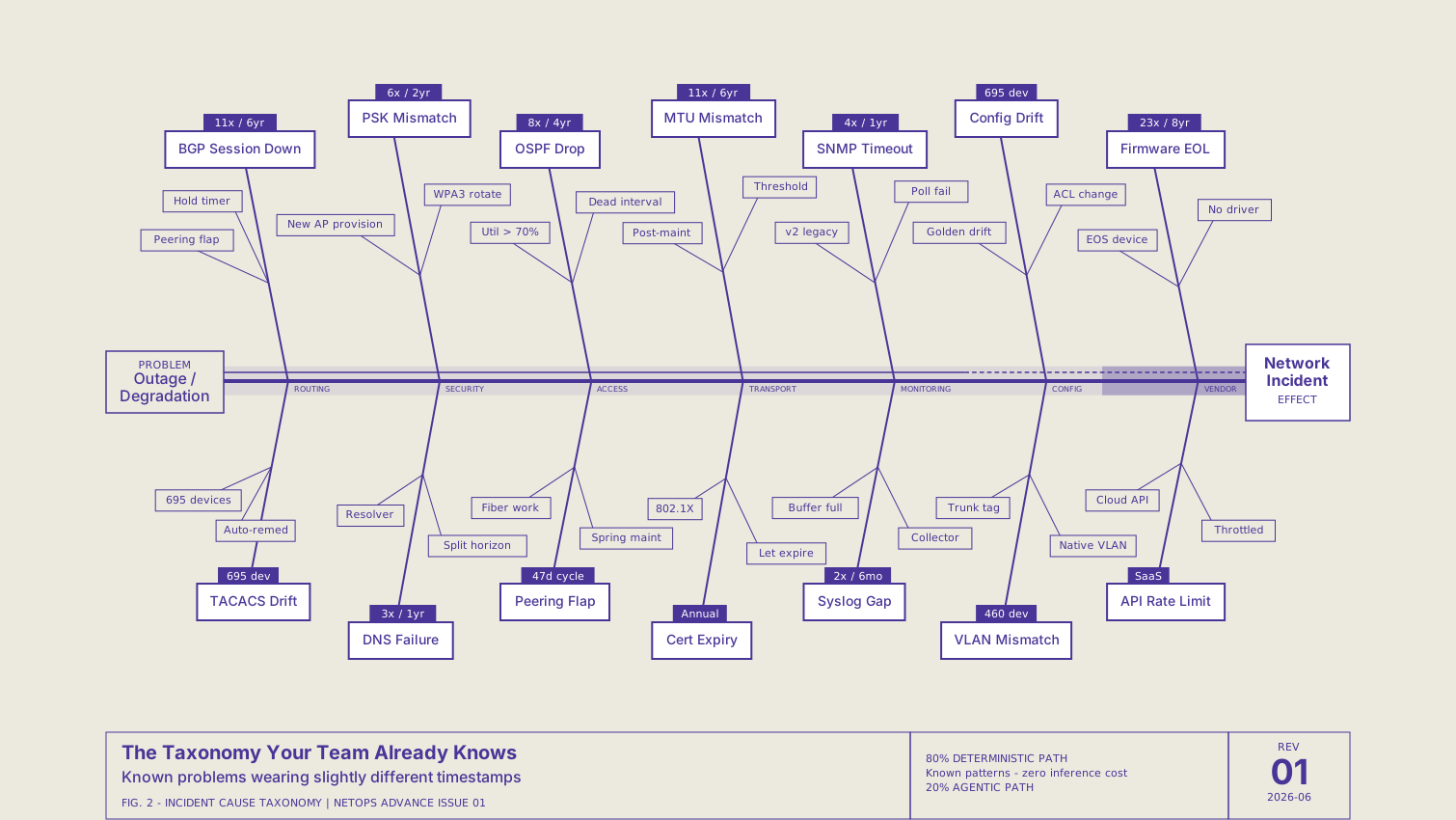
They’re variations on patterns the team has already seen, diagnosed, and resolved — some of them dozens of times.
- The BGP session that resets on the same peering link after maintenance windows
- The PSK mismatch that surfaces whenever a new access point is provisioned in a specific building
- The OSPF neighbor that drops whenever upstream utilization crosses 70 percent or during peak traffic windows
These are not mysteries. They are known problems wearing slightly different timestamps.
The Gartner® Market Guide for Agentic NetOps Software (G00851978, May 2026) identifies runbook-based deterministic resolution as the appropriate mechanism for the majority of network incidents. Events that follow known patterns and require certainty, not reasoning.
The architecture question for any Agentic NetOps deployment isn’t “How do we get AI into our network operations?” The critical question that most teams aren’t asking is this:
Which 80 percent do we resolve deterministically and which 20 percent do we route to the agent?
The teams that get this wrong, treat every incident as a potential Deep Diagnosis candidate. They route everything through LLM reasoning. The diagnostic engine returns an answer. Many times, a good answer. But at enterprise event volume, the economics become a problem faster than anyone projected in the pilot phase. More on that in a moment.
The teams that get this right build from a different premise: certainty is a design goal, not a side effect. Known incidents get resolved deterministically, the same way every time. No inference cost. No latency. No ambiguity about what happened.
Unknown incidents get the full weight of agentic reasoning: multi-step analysis across telemetry, topology, historical data, and policy context. The engineer’s expertise funds the first layer. The agent earns its keep on the second.
This is the incident taxonomy your senior network engineer has been carrying in her head since her second year on the team. The platform makes it explicit, executable, and permanent.
SECTION 2
The Architecture That Makes It Work
The tiered intelligence model is an architecture principle, not a product feature. The distinction between layers is where the entire economic and operational argument lives. Understand that distinction and the platform makes sense. Miss it, and you have bought a very expensive incident-routing system.
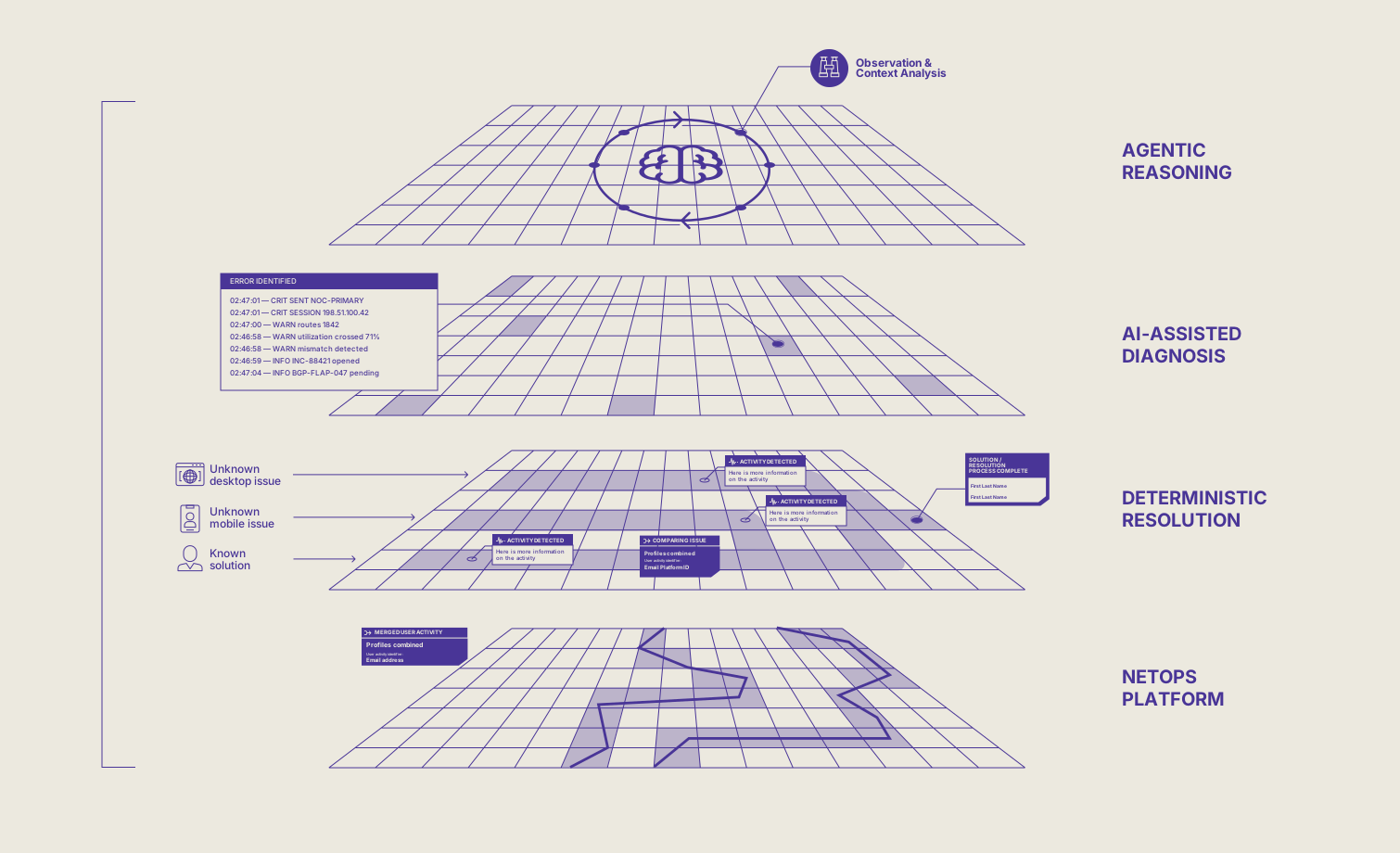
The first layer is deterministic resolution. When the platform encounters a known incident, it resolves the problem the same way every time. No inference call. No LLM reasoning. No latency while a model works through the problem. The outcome is auditable, repeatable, and governed. The engineer can see exactly what happened and why.
This is not the human removed from the loop. It is the human removed from resolution paths on cases where the answer was never in question.
The human stays on the loop; the platform handles the execution.
The second layer is AI-assisted diagnosis. For incidents that require judgment but not deep reasoning, the platform surfaces the most relevant next steps so she acts faster and with more information.
The third layer is agentic reasoning. For the 20 percent of issues that genuinely require it:
- Novel failure modes
- Cross-domain causality
- Conditions with no runbook precedent
The agent works through the problem the way your best engineer would, but with access to the full telemetry stack and without the constraint of a single shift’s working memory.
The architecture question isn’t “which layer is most powerful?” It’s “which incidents belong in which layer?” Most engineers can answer this intuitively. They have been sorting incidents mentally for years.
The BGP reset belongs in layer one. A novel SD-WAN degradation with multi-site correlation belongs in layer three. The architecture makes the sorting explicit, codifies it, and removes the human from the execution path on the first layer, where 80 percent of the volume lives.
This is the economic logic: Zero inference cost on 80 percent of events is not an efficiency metric. It is a structural advantage that compounds every month the platform runs.
SECTION 3
What Happens When You Don’t Build the Architecture
The Gartner Market Guide for Agentic NetOps Software (G00851978, May 2026) contains a warning most vendor briefings will not quote:
Through 2027, enterprises that buy agentic NetOps software using uncapped variable pricing models tied to token usage will exceed initial cost expectations by over 50% compared to those using predictable subscription and bundled models.
That is not a projection about market hype. It’s a structural consequence of routing every incident through LLM inference. Every incident. Known and unknown. Simple and complex.
The math at enterprise event volume makes the trap visible before you are deep in it. At published API rates — not Gartner projections, not NetBrain figures — a single agentic network diagnosis event involving 10,000 input tokens and 2,000 output tokens costs approximately $0.06 per event. At 10,000 events per month, that is roughly $600 in inference cost alone, or $7,200 per year. At 50,000 events per month (a realistic production volume for a mid-sized enterprise), the figure climbs to $3,000 per month or $36,000 per year. That’s before compute, integration, or orchestration costs. Industry analysis notes that reasoning models can reach $3 per complex call. Those costs are negligible in a pilot, but material at 10,000 calls per day.
Gartner is explicit about why:
Model inference cost is a material driver of total expense. In production environments, agentic systems rarely perform isolated actions. Instead, they execute multistep reasoning across telemetry, topology, historical data, and policy context.
As a result, seemingly modest interactions can generate disproportionate background processing costs as reasoning depth and operational scope increase.
The tiered architecture from Section 2 is not an elegant design choice. It is an economic necessity. When the deterministic layer handles known incidents without a single inference call, the remaining 20 percent can use the full weight of agentic reasoning. Because you can afford to.
Teams that know their per-incident cost is zero for deterministic resolution and bounded for agentic diagnosis make different decisions during critical incidents. They do not hesitate to run the Deep Diagnosis when the novel failure mode appears at 2:47 AM. That is the architecture argument. The pricing model is the implementation of it.
SECTION 4
Certainty as a Compounding Asset
At CenterPoint Energy, a large North American utility, an OSPF incident resolved by the platform did not simply close a ticket. It fed permanently into the Post-Mortem Assessment Dashboard as a preventive check. A codified resolution that the platform would apply the next time the same failure pattern appeared, before the page went out.
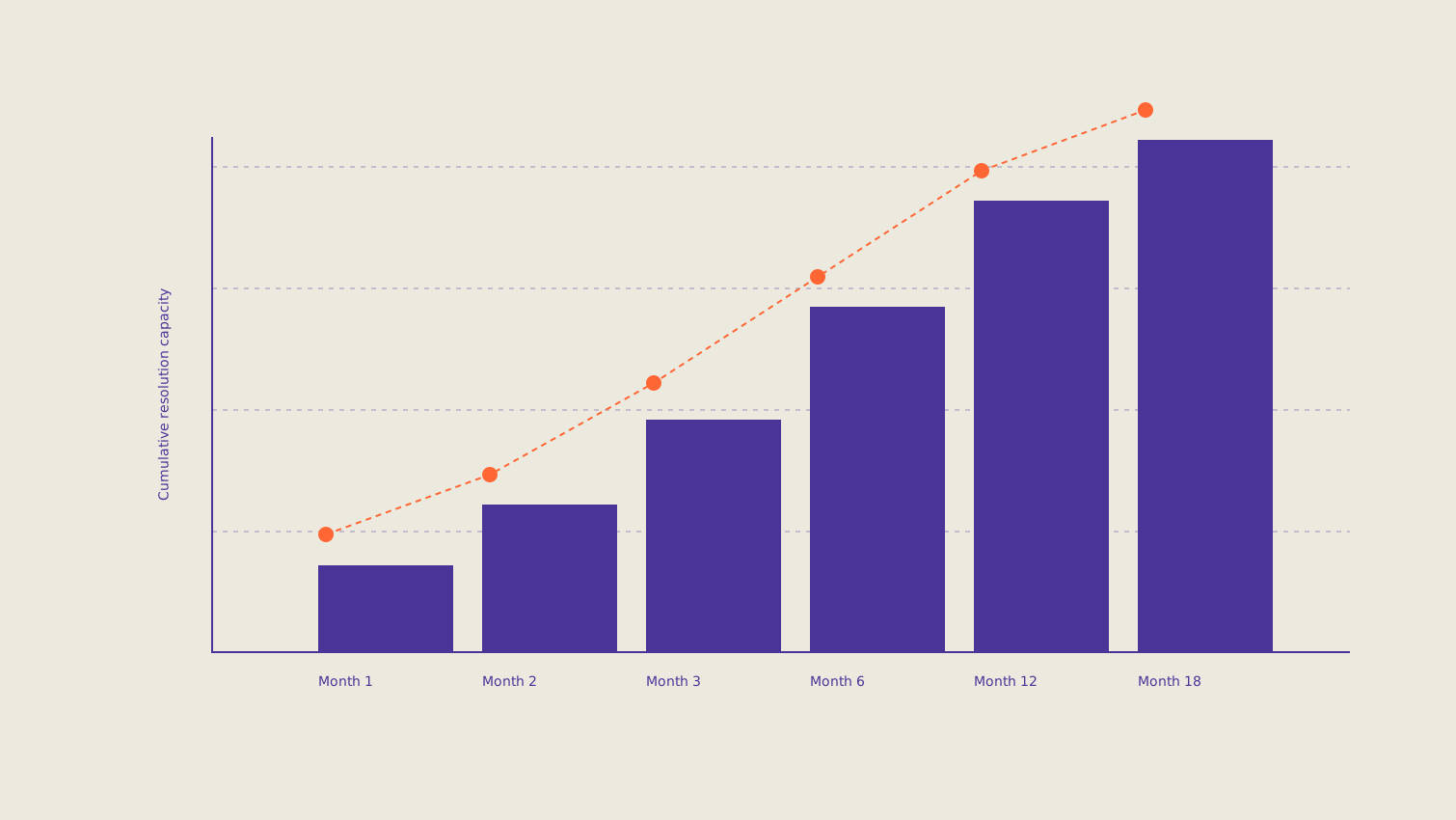
That is the compounding mechanism in production, not in theory. Each resolved incident becomes a reduction in future uncertainty, instead of a reduction in future workload.
The platform resolves the incident in a way that makes the next similar incident cheaper. And eventually free.
The OSPF resolution that ran at 2:47 AM last Thursday is the deterministic answer for the next engineer who faces the same alert. The TACACS compliance drift that the platform auto-remediated across 695 devices becomes the baseline check that catches the next deviation before it becomes an outage. The SNMPv2 instances upgraded across 460 devices become the standard against which future provisioning is validated automatically.
Each action compounds.
The engineer who resolved that OSPF issue at 2:47 AM last Thursday just trained her replacement. And her replacement is the platform, not a junior hire. Her diagnostic reasoning, which previously lived only in her memory, becomes the deterministic layer’s next resolution. Her knowledge does not retire when she does. The platform carries it forward.
Institutional knowledge was always the team’s most fragile asset. Now, pattern recognition that took six years to develop doesn’t walk out the door with every senior engineer who moved to cloud or security for better pay. It’s codified. Permanent. Executable.
This is the argument the brief calls the Key Insight: Agentic NetOps is not a cost reduction play. It is an institutional knowledge preservation and amplification play.
The certainty compounds. The team that has been resolving incidents deterministically for twelve months has a fundamentally different capability floor than the team that has been routing the same incidents to senior engineers. The gap between them is not about technology. It is about what the platform already knows.
SECTION 5
What the Engineer Does Next
There is a version of this story that sells the engineer short. It goes: “free up your engineers from firefighting so they can do more strategic work.” This version is technically true and practically wrong.
The most honest version of what happens when Agentic NetOps absorbs the known-incident workload comes from Omdia analyst Jim Frey, who put it directly: engineers don’t suddenly graduate to prestigious projects. Instead, they have capacity for the work they could not anticipate.
That distinction matters. The thing that burns out your best network engineers is the relentlessness of the work. The 2:47 AM page that interrupts the architectural planning session that got interrupted by the compliance audit that followed the production outage that was caused by the change that was rushed because the team was still recovering from the last 2:47 AM page. The endless loop breaks people more than the individual incidents themselves.
The endless loop breaks people more than the individual incidents themselves.
When a large North American utility automated the majority of their tickets and reclaimed thousands of hours annually, here is what actually changed: engineers who had been starting their days reacting to what had already broken started asking what might break next. Prevention moved from being a quarterly project to being the default posture. The team is no longer bounded by how many devices an engineer can touch in a day. They are bounded by how many architectural problems they can think about in a week. This is a different and much better ceiling.
The senior engineer who diagnosed that BGP session reset at 2:47 AM for eleven years did not lose her expertise when the platform absorbed the incident. She contributed it. Her diagnostic pattern — the MTU mismatch, the specific conditions, the resolution path — became the deterministic layer’s answer for the next engineer who faces the same alert. Her knowledge does not retire when she does. The platform carries it forward.
This is what Agentic NetOps actually offers the Director of Network Operations: not a headcount argument, not an efficiency claim, but a different answer to the question she cannot stop asking.
What happens to this team’s institutional knowledge when the best people on it start updating their LinkedIn? The answer, finally, is not “we hope they write good runbooks before they leave.” The answer is that the platform has already been learning from them for years.
SECTION 6
Conclusion — The 3 AM hero is not retiring
She’s being promoted — into the architecture, into the strategy layer, into the questions the platform cannot yet ask. The incidents she has been diagnosing for six years are now the platform’s baseline. What she does next is not constrained by what broke last night.

That’s not a vision statement. It’s the operating model that a handful of network organizations are already running. The gap between them and everyone else compounds every month. Every incident a team resolves deterministically is one their peers are still routing to a senior engineer at 2:47 AM. Every resolved incident that feeds back into the platform as a permanent preventive check is one their peers will route to a senior engineer next year too.
The five-pillar framework Gartner describes in their May 2026 Market Guide — baseline, reason, integrate, trigger, effect — is a description of what the operating model looks like when it’s working.
Ready to move from argument to architecture? Read Issue 2 of this series to dive deeper on what the Gartner analysis got right and what it left out.