Introduction
The limits NetOps is hitting
For years, the answer to a harder network was a more skilled engineer. That answer is unattainable. Modern networks span:
- On-premises
- Several clouds
- SD-WAN
- Security overlays
- Hardware stretching across many generations of technology
The volume of change, the number of moving parts, and the ambiguity of the signals have all grown faster than any team can staff against.
The constraint is no longer expertise. It is the speed and scale at which expertise has to be applied.
That’s where Agentic NetOps comes in: an autonomous approach powered by AI agents that reasons about the live state of your network and acts within the guardrails you set. Not a chatbot bolted onto a dashboard, and not a script that runs the same way every time regardless of what it finds. Software that investigates, reaches a conclusion, and, when you allow it, does something about it. In May, Gartner issued their inaugural “Market Guide for Agentic NetOps Software” signaling the true emergence of this market. They represent what we have been building toward for years, and we want to share how we think about getting it right.
SECTION 1
The hard problem is multi-vendor and multi-generational
Most conversations about heterogeneous networks stop at multi-vendor. In a large enterprise, the harder truth is multi-generational. When you are troubleshooting, any device can be the culprit:
- An SD-WAN edge
- A cloud VPC
- A Kubernetes overlay
- A controller-managed campus switch
- A switch two generations old that no one has logged into in years
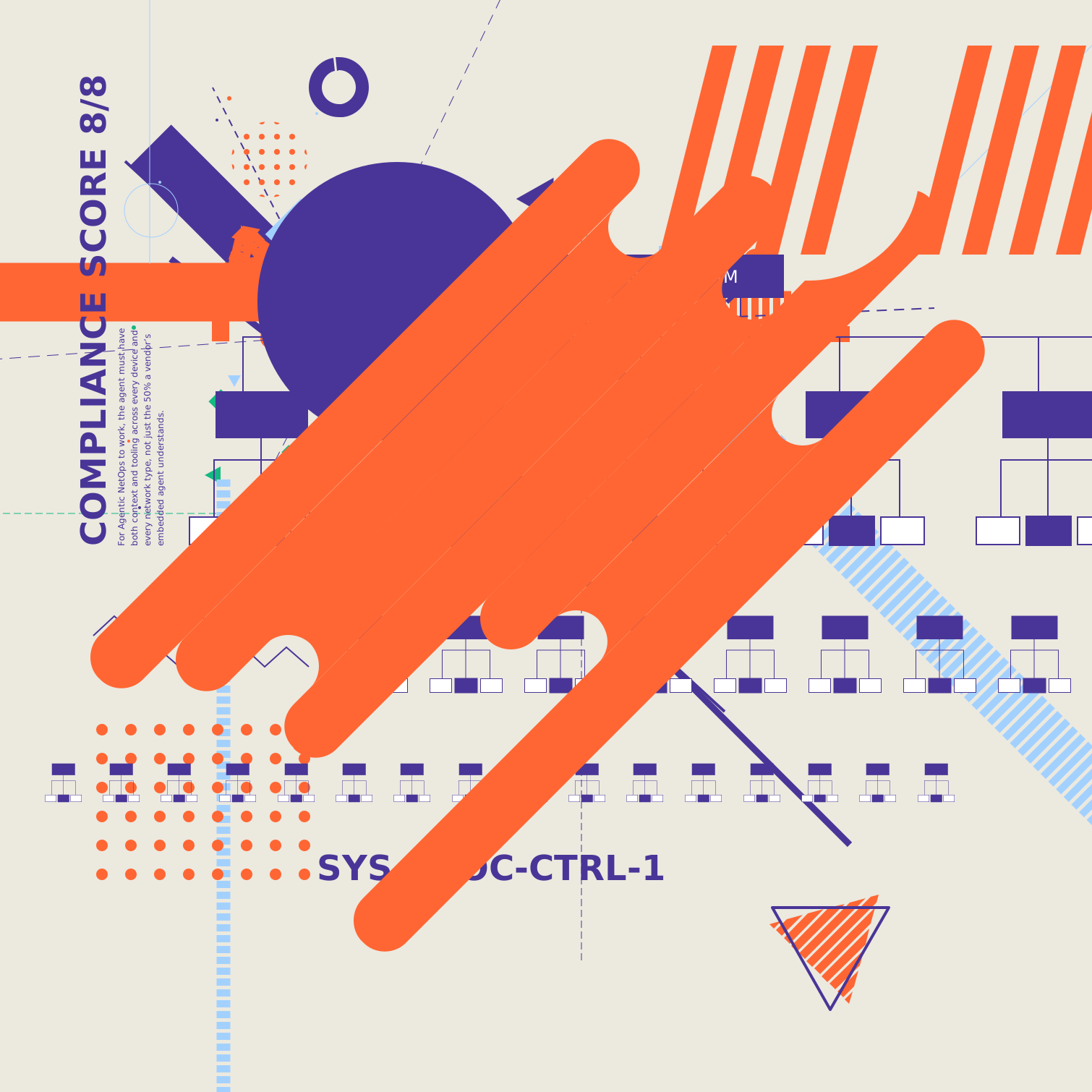
Older devices bring their own compounding challenge: limited APIs, inconsistent data models, and sparse telemetry are the exact conditions that cause a modern agent to go blind.
For agentic operations to hold up, the software needs both context and reach across every device and every network type, not the slice that one vendor’s embedded agent happens to understand.
An agent that goes blind the moment it crosses a domain boundary or meets an older platform will fail exactly when an operator needs it most.
NetBrain’s live network context exists to close that gap. It reaches across hundreds of vendors, technologies, and device generations so the software reasons over the whole network, not a fraction of it. Add cloud, which nearly every network now includes, and the bar rises again.
SECTION 2
Autonomy is a decision, not a default
Moving work to Agents is not a single switch you flip.
It is a series of deliberate choices about what to hand over, where, and when. You might automate a specific set of pre-approved CVE updates and nothing else. You might run one level of autonomy in the data center and a more conservative one at the branch. You might decide by ticket type, or even by application. Setting those rules is the real work, and it is exactly what NetBrain Intent was designed to hold. Your network, your choice.
We think about autonomy in stages:
01
AUTONOMY STAGE
Reactive
CONTROL MODEL
Engineer-driven, software-assisted. The engineer does the work; the platform makes them faster.
02
AUTONOMY STAGE
Proactive
CONTROL MODEL
Software proposes, human approves. The system recommends each step; a person signs off before anything executes.
03
AUTONOMY STAGE
Predictive
CONTROL MODEL
Software runs, human observes. The system carries out a multi-step process while a person watches and can step in.
04
AUTONOMY STAGE
Autonomous
CONTROL MODEL
Governed. Trusted, narrowly scoped processes run from ticket to resolution under policy, with rollback.
The skill is choosing which workflows graduate to which stage, and earning the trust to move them there. NetBrain is built to walk that path deliberately, starting supervised and widening autonomy only where validation, explainability, and rollback have proven a process safe. And the people guiding that path matter: your teams are network professionals with the experience to know which workflows are ready and which are not.
SECTION 3
Trust comes from reasoning you can defend
Here is where we take a position some will disagree with. We do not think the goal is software that hands you a confidence score and a probability. When a network decision affects production, “85% sure” is not something you can stand behind in a change review.
NetBrain’s approach is to reason freely and execute precisely.
The software follows the network, checks the evidence, and reaches a conclusion that can be traced, reviewed, and defended, the same way a senior engineer would walk you through their thinking. That is the foundation that makes wider autonomy possible. You do not delegate to a system you cannot audit.
The Runbook Companion Agent is what supervised autonomy looks like in practice. Engineers ask plain-language questions about results, explore alternative remediation paths, and get a push or do-not-push verdict for each device before a single command is sent, with the reason cited. After execution, it verifies the outcome on every device in scope and condenses the result to one line per device. Institutional knowledge stops being a static document and becomes something the whole team can query and build on.
SECTION 4
The engine is the learning loop
The part we are most excited about is what happens after a problem is solved. Every diagnosis uncovers truth about how your live network is actually behaving: where it has drifted from the Intent, where the configuration and the architecture have quietly diverged, where reality stopped matching the design. At the pace most teams run, that insight evaporates. The post-mortem rarely happens.
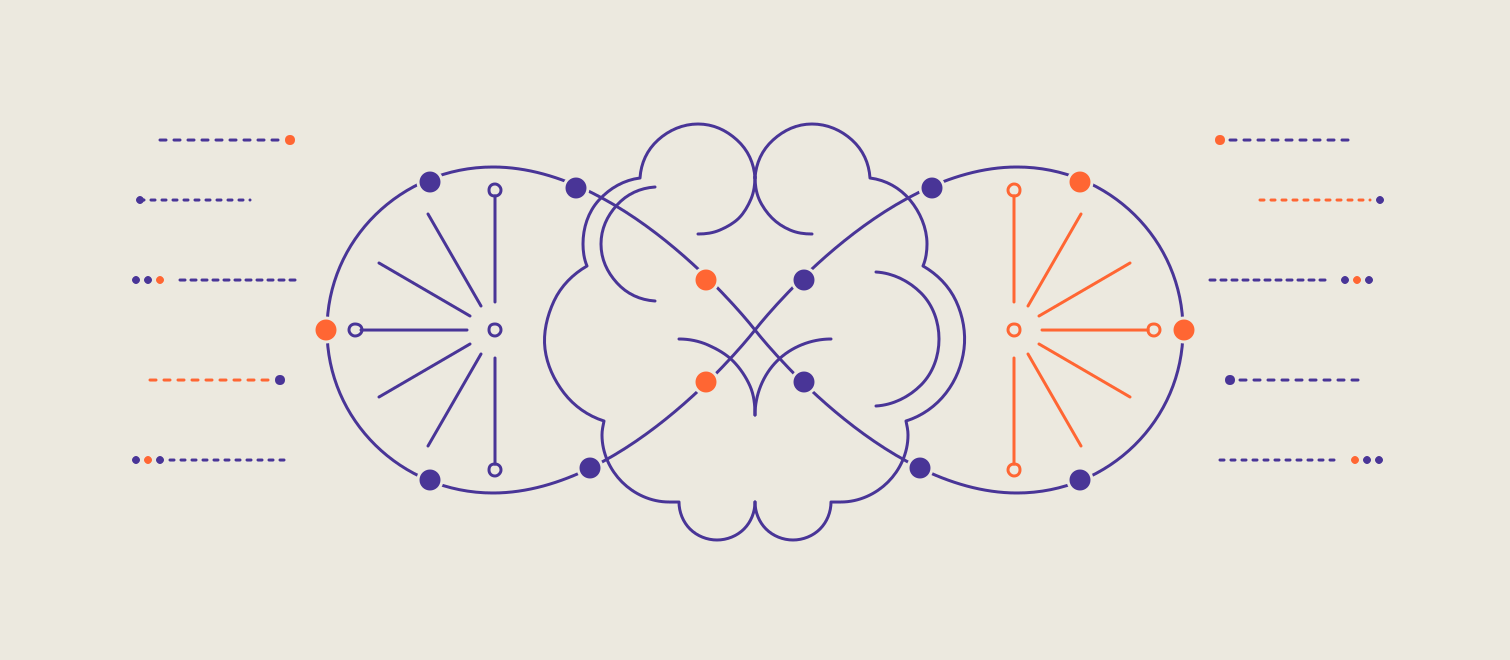
In NetBrain, the reasoning behind a completed diagnosis is captured as a new runbook and promoted into approved automation. The intent you just uncovered becomes something the system can reuse, and proactively hunt for everywhere else the same condition might be hiding. So, two things happen each time NetBrain resolves an issue: it resolved faster because the work was agentic, and the operation got permanently smarter because the knowledge was captured instead of lost.
The context from this diagnosis makes the next one sharper. That is the compounding part.
SECTION 6
Conclusion – Where to start
If you take one thing from how we see this, start with diagnosis. It is where your network’s real state meets its intended state, where the learning loop begins, and where trust in autonomous operations is either earned or lost.
We believe the inaugural Gartner® Market Guide for Agentic NetOps Software1 confirms it: agentic NetOps “delivers the most value where manual investigation, diagnosis, validation, and multidomain response dominate operational time and cost.”
Change validation, governance, and prevention each depend on getting diagnosis right first.
So start there. Take a look at Deep Diagnosis. We think you will see what we mean.
1 Gartner, Market Guide for Agentic NetOps Software, 19 May 2026, Mike Leibovitz Et Al.
Gartner is a trademark of Gartner, Inc., and/or its affiliates.